The Children's Playground Co. Ltd.
Robinia Wood information

Description of Robinia

Abbreviation: ROB, DIN 4076 Part 1

Botanical name: Robinia pseudoacacia L.

Other Name: False acacia

Where does it grow:

The robinia tree was introduced at the beginning of the 17th century to Europe. 
The original home was the North American East.
Today it is found in the middle and South of Europe. With  increasing 
industrialisation a new interest was found in the economic viability of the tree, 
especially the railway producers who planted the robiniabecause of the distinct 
root system to strenghten the embankment of the track.

About the wood:

Robinia can grow up to 30 meters in height, The knot free trunk length comes to 
approx.10 m. The diameter of the usable wood rests between 0.15 - 0.4m. 
Single trunks can reach a diameter of 0.8m, sometimes up to 1m. 
The trunks are often irregular, crooked, that is why the tree gets a low value 
from foresters. Better location and better care raises the quality enormously.   

Characteristics:

The Robinia is a compact wood at 0.75 g/cm³ with wood humidity from 12 -15%.
It is one of the heaviest of all used wood in Europe. Accordingly the wood is 
very hard and at the same time it is also very tough combined with a high 
elasticity and it is much harder than oak.
The robinia is the only European wood that is in resistance class 1. 
For this reason it is allowed to be used without chemical wood protection for the 
building of playground equipment, DIN EN 350-2 
Previous examination results prove no health dangers from the contents of the Robinia.

Purpose of Robinia:

Because of its "unusual" growing characteristics it is difficult to get it in large 
amounts, but because of its good material qualities it can be used in many ways. 
In the past it was used many times as fencing poles. It can be used in situations 
where high mechanical demands and extreme environment conditions come together.

Examples:
Excavation of the ground and waterways construction e.g. watermills,canals, 
shipbuilding (planks, prows, rudder pins,  shipnails). Docks for inland and bridges, 
seaports (drydock, platforms), the food industry (spirits, barrels, winebarrels), 
mineshaft and spring water wells, wheels, toolgrips, and of course 
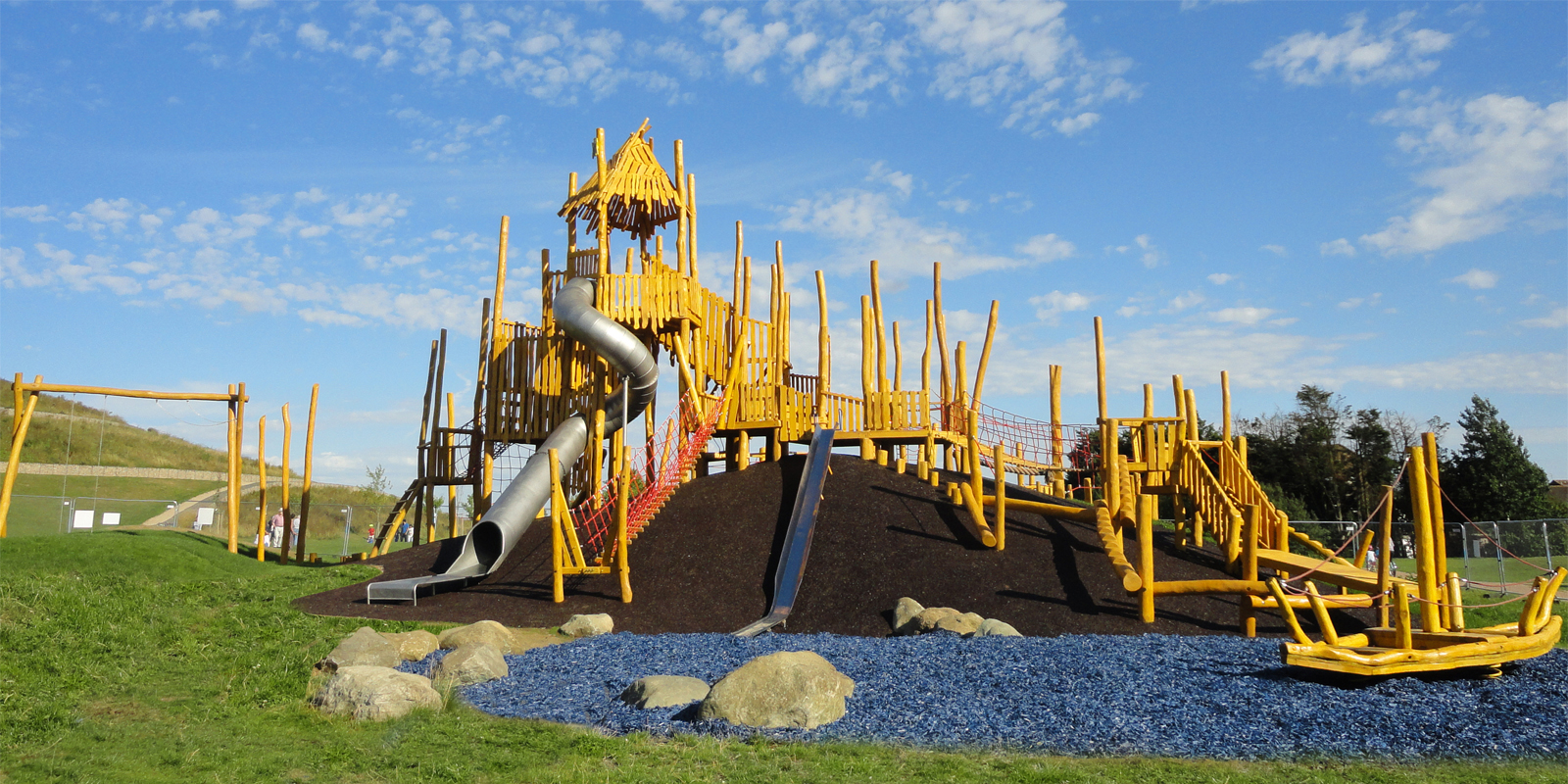
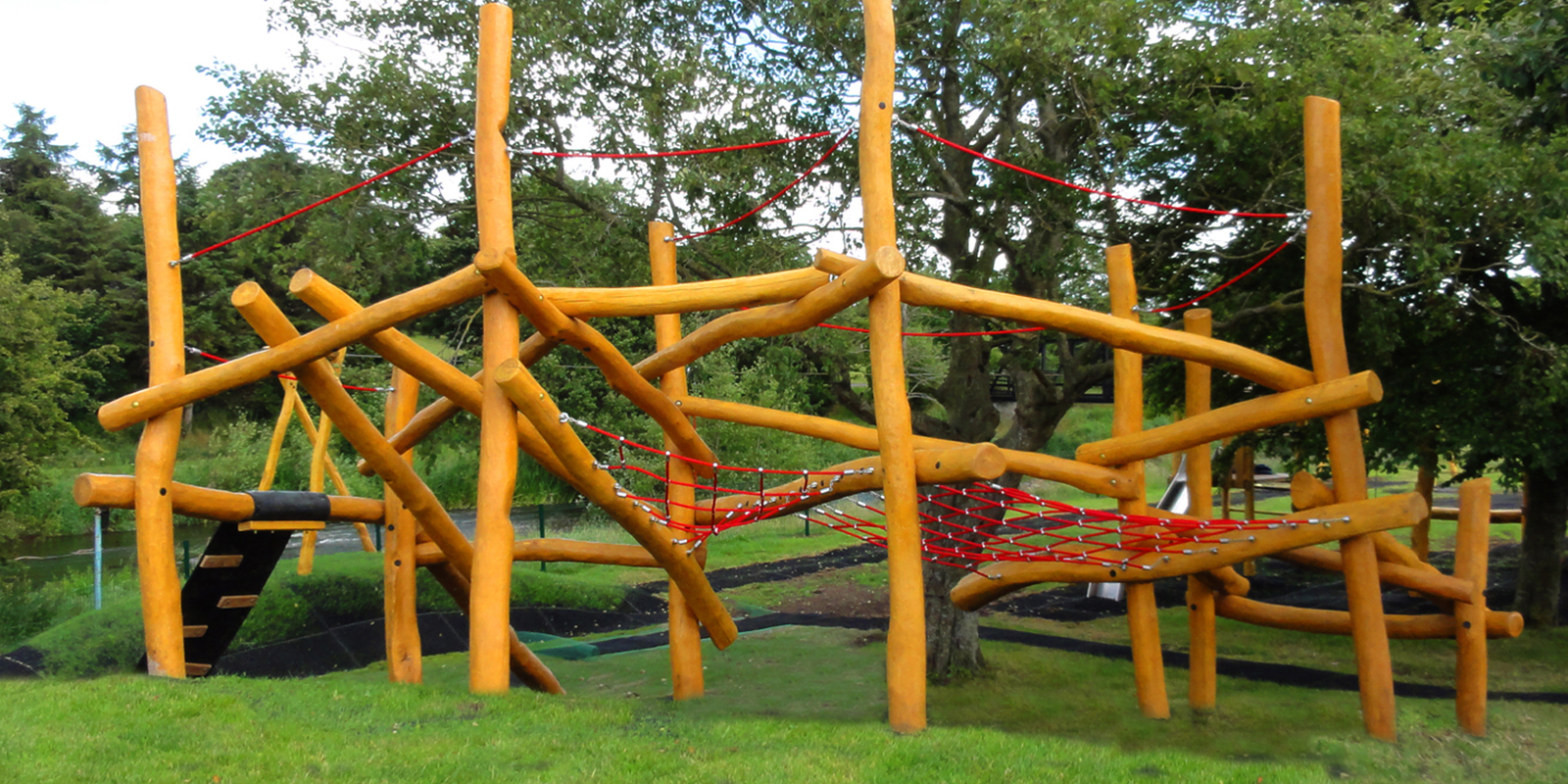
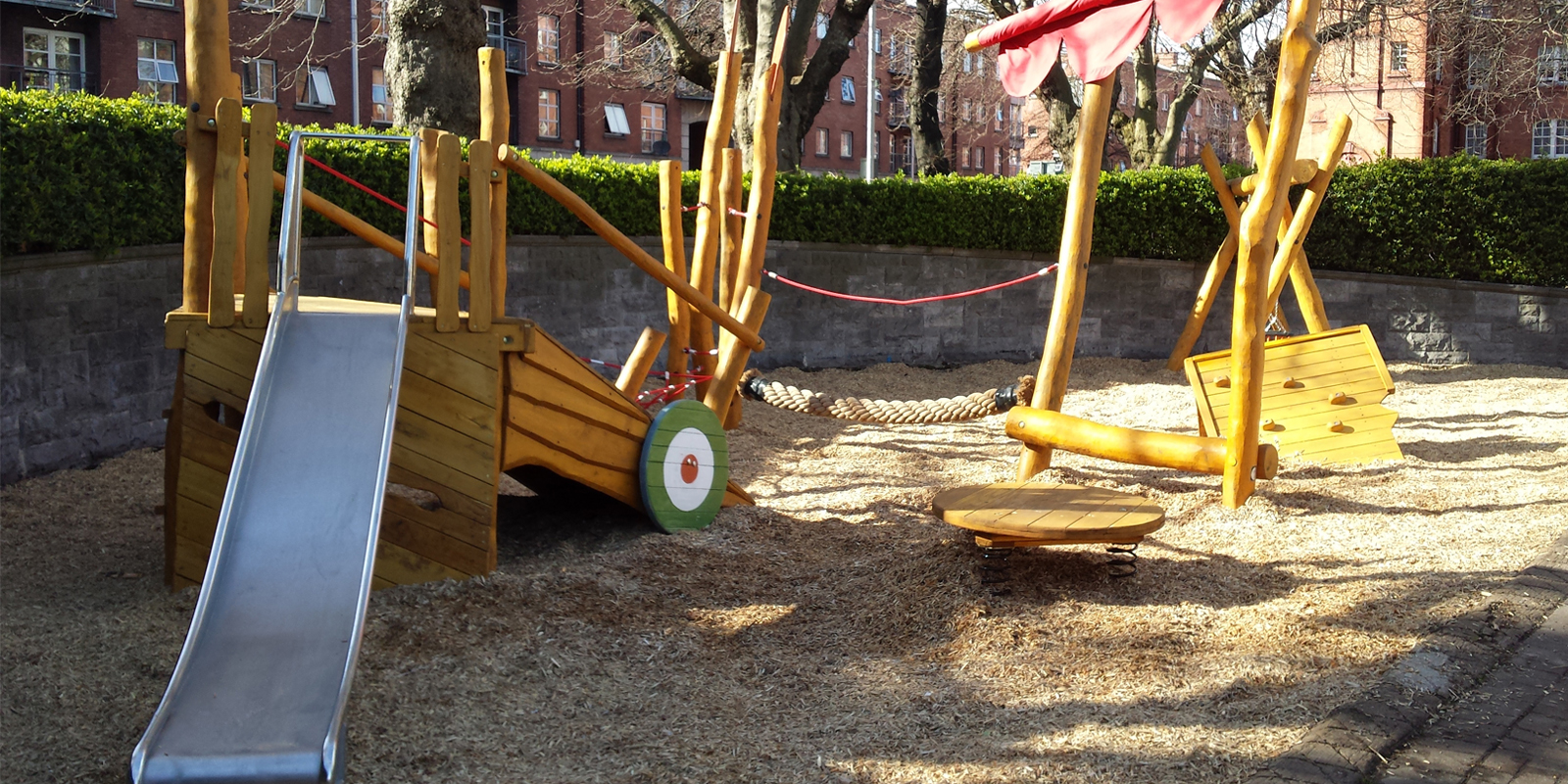
...........PLAYGROUND EQUIPMENT.

Wood characteristics

Over a period of time wood changes its physical qualities. These qualites are 
clearly visible, when the volume or the shape change. 
But what causes it, and how do you get around it? 

Hygroscopicity

Wood is a very hygroscopic material. This means in steady humidity the colour changes 
with the air. Wood humidity is the amount of liquid parts in the wood substance. 
It takes the form of water content. The ability to absorbe and to release water 
content is a result of the capillary porous wood structure. This structural 
characteristic influences all physical and technical capacities of the wood. 
Hygroscopicity is also the ability of solid, capillary porous materials, to receive 
humidity from the surrounding air until repletion and to release it in drier conditions.

Expansion & contraction these are the results of the changes in humidity.

Expansion is the increase in the measurements, because of the water absorbtion until the
turgor pressure is at its maximum (woodhumidity u=28-0%).

Contraction is the decrease in the measurements, because of vaporisation until all the 
water is released (woodhumidity u=0 - 28%).
The inner cores of the wood expand and contract less than the areas in the outer core area.
In comparison to the pine, spruces or oak the robinia has the lowest value of expansion. 

Grooves/Cracks

These are the result of the separation of the fibre connections length-wise. That means, 
they are running (axially, tangentially) or as a combination between radial and 
tangential fissures. They arise also when the wood contracts by dehumidifying, when the 
wood expands by ice-building in the pores area and by interior growing tensions. 
Fissures normally don`t reduce the quality of the timber. 
According to DIN EN 1176 they make no direct demandregarding the complexion and the 
character of wood fissures. They don't see the woodcracks which result from the wood 
dehumidifying as problematic.

Only, according to DIN 31 001, fissures can be graded. The mass >8 mm as a source of 
danger to fingers is counted only after a falling height of over 1200 mm. 
Below this height open fissures represent  no danger. 

Woodprotection

For the fabrication of our equipment we use exclusively robinia trees, that have 
larger diameters than oak. This wood has a long life because of its high resistance. 
Equipment parts, which are in continuous contact with earth and water, are burned. 
The escaping gases condense to natural tars  at the wood surface and form 
a watertight film. This process guarantees "in the earth and air area"a lasting 
product for decades. In addition to this, we follow the criteria of the wood protection 
programme in the construction and manufacturing of our equipment.


Source:

1."Einheimische Nutzhölzer", Centr.Marketinggesell.der dt.Agrarwirtschft Holz
2. Wagenführer/Schreiber. Holzatlas, Fachbuchverlag Leipzig 1984
3. DIN 68 364 Beuth Verlag, DIN EN 1176 Beuth Verlag 1998